The ‘Holy Water’ of Ireland
Imagine, if you ever found yourself on a winter's evening, sitting by a crackling turf fire, in a little cottage tucked away in a remote part of rural Ireland. In an atmosphere that was easy, warm, simple and friendly and where smoke curled lazily from a stone chimney. There was every chance that after the kettle had boiled and the news had been exchanged, someone would quietly disappear into the back room and return carrying an old bottle with no label. "A drop of the good stuff," the man of the house would whisper with a knowing smile, and before long tiny glasses would be filled with Ireland's oldest and most mysterious spirit, poitín (pronounced - put-cheen). If you are not familiar, then dig out the Pogues and Dubliners recording of “The rare auld mountain dew”.
There's a neat little still at the foot of the hill where the smoke curls up to the sky
By a whiff of the smell you can plainly tell that there's, poitín boys, close by
For it fills the air with a perfume rare and betwixt both me and you
As home we roll, we can drink a bowl or a bucketful of Mountain Dew 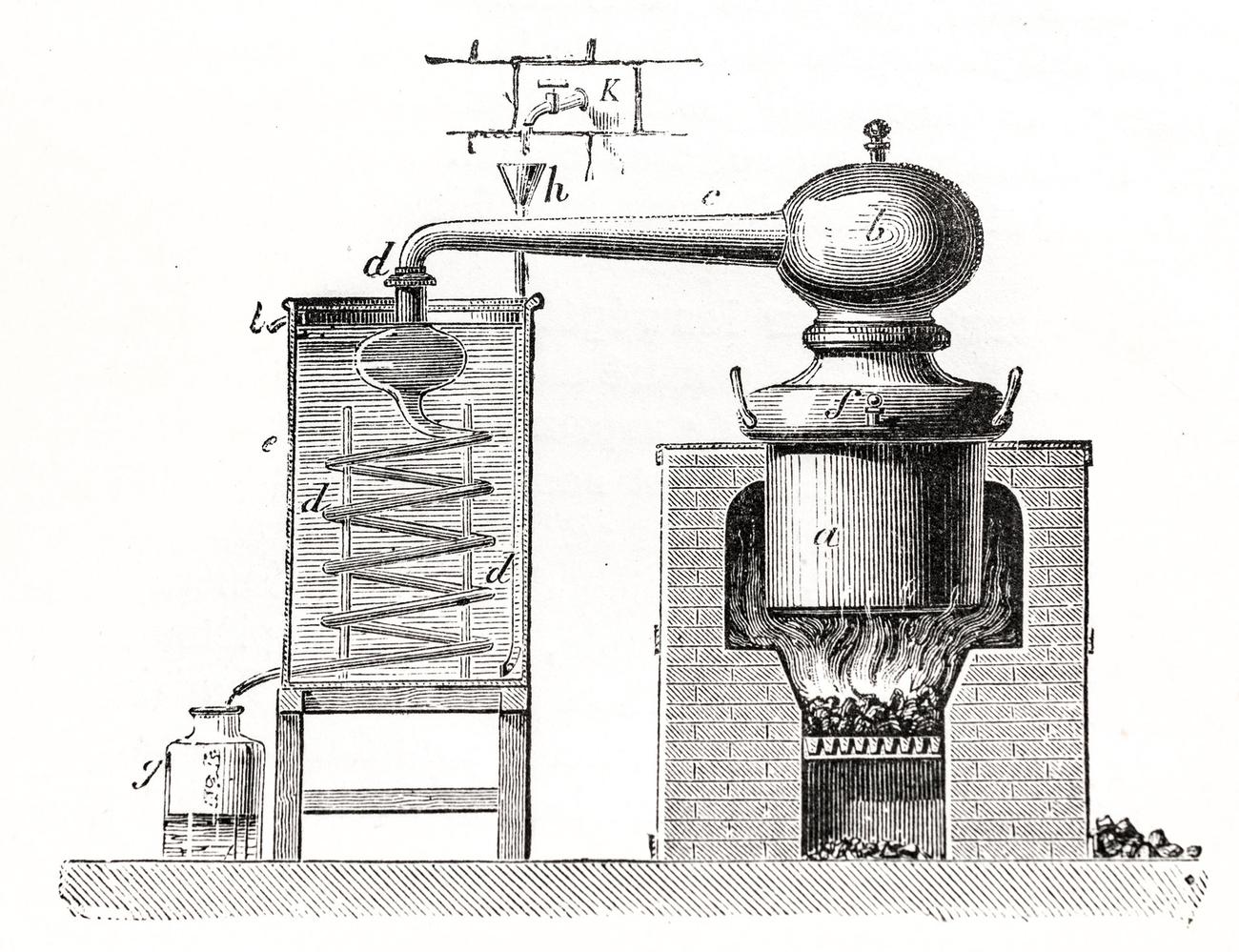
The Principle of an alcholic spirit Still
They say the name comes from the little copper pot, an pota, that sat over a turf fire while clear liquid slowly trickled from the still. Whether the first drop was made by monks a thousand years ago or by some clever farmer with more potatoes and barley than money, nobody can say for certain. But one thing is beyond argument—the Irish had mastered the making of poitín, long before the taxman discovered it. And once the occupying English government decided to tax it in the 17th Century, the making of poitín became as secret as the hiding place of fairy gold. The homemade stills vanished into the hills, valleys, and remote bogs, where only the sheep, the curlews and the man who owned the still, knew where they were. Children became lookouts, dogs barked warnings, and neighbours suddenly developed an astonishing interest in watching the road whenever an excise officer happened to be passing. It became almost a sport, and more often than not, the law arrived just in time to find a cold fire, an empty shed and a farmer looking entirely innocent.
Every parish had its own poitín maker, and every poitín maker claimed his was the finest in Ireland. Family recipes were handed down as carefully as the family Bible. Some swore by barley, others favoured oats or potatoes, while a few added ingredients they would sooner reveal on Judgment Day, than tell another living soul. However, the final spirit was as varied as the characters on a fair day. Some poitín slipped down as smoothly as fresh cream and other batches could take the enamel off a shovel. An old fellow once declared, "If your eyes don't water after the first sip, somebody forgot to put the poitín in the bottle."
There wasn't too many ailments that poitín couldn't cure either—or so the old people believed. A spoonful with honey chased away a cough. A splash in hot tea frightened off a cold. Rub it into aching knees and you'd be dancing a set before bedtime. It soothed toothache, eased rheumatism and warmed frozen hands after a day cutting turf. There were even those who maintained it cured a broken heart, though the evidence for that particular miracle remains gloriously unproven. Poitín wasn't simply a drink; it was part of life's great occasions. At a wedding, a quiet glass settled the nerves of the groom and gave courage to the father of the bride before his speech. At a christening, the baby's health was toasted before anyone argued over whose nose the child had inherited. At wakes and funerals, when grief sat heavy in the room, a shared glass somehow loosened memories instead of tears. Before the night was over there would be stories, songs, laughter and somebody insisting that the deceased had once caught a salmon "the length of a bicycle." Sure wasn’t this the Irish way.
Even on St. Patrick's Day, Christmas or after the harvest, the bottle made its appearance, not for excess, but for friendship. One glass became conversation, conversation became music, and before long someone had produced a fiddle while another attempted a song that improved remarkably as everyone else joined in and drowned out the starter. The remarkable thing about poitín was that no two bottles were ever quite alike. One could be as gentle as spring rain, while the next would make your ears ring like chapel bells. As an old neighbour used to say, "The first glass makes you cheerful, the second makes you philosophical, and the third convinces you that you can sing better than Count John McCormack."
Nowadays, you can buy fine legal poitín in handsome bottles from licensed Irish distilleries, polished and refined for a new generation. Yet somehow the old stories still cling to its culture. For every bottle sold today, there are a hundred tales about hidden stills, moonlit journeys across bogs, narrow escapes from the excise men and secret recipes carried faithfully from father to son. Perhaps that is the true spirit of poitín, it was never merely about strong drink. It was about neighbours calling without invitation, music filling a kitchen, stories growing taller with every telling, and laughter echoing long after the glasses were empty. And if, before leaving, an old neighbour pressed a small unlabelled bottle into your hand with the words, "A little drop of ‘holy water’ for the winter's night that’s in it," you'd know you had been given something far more valuable than a drink. You had been trusted with a little piece of Ireland’s soul.
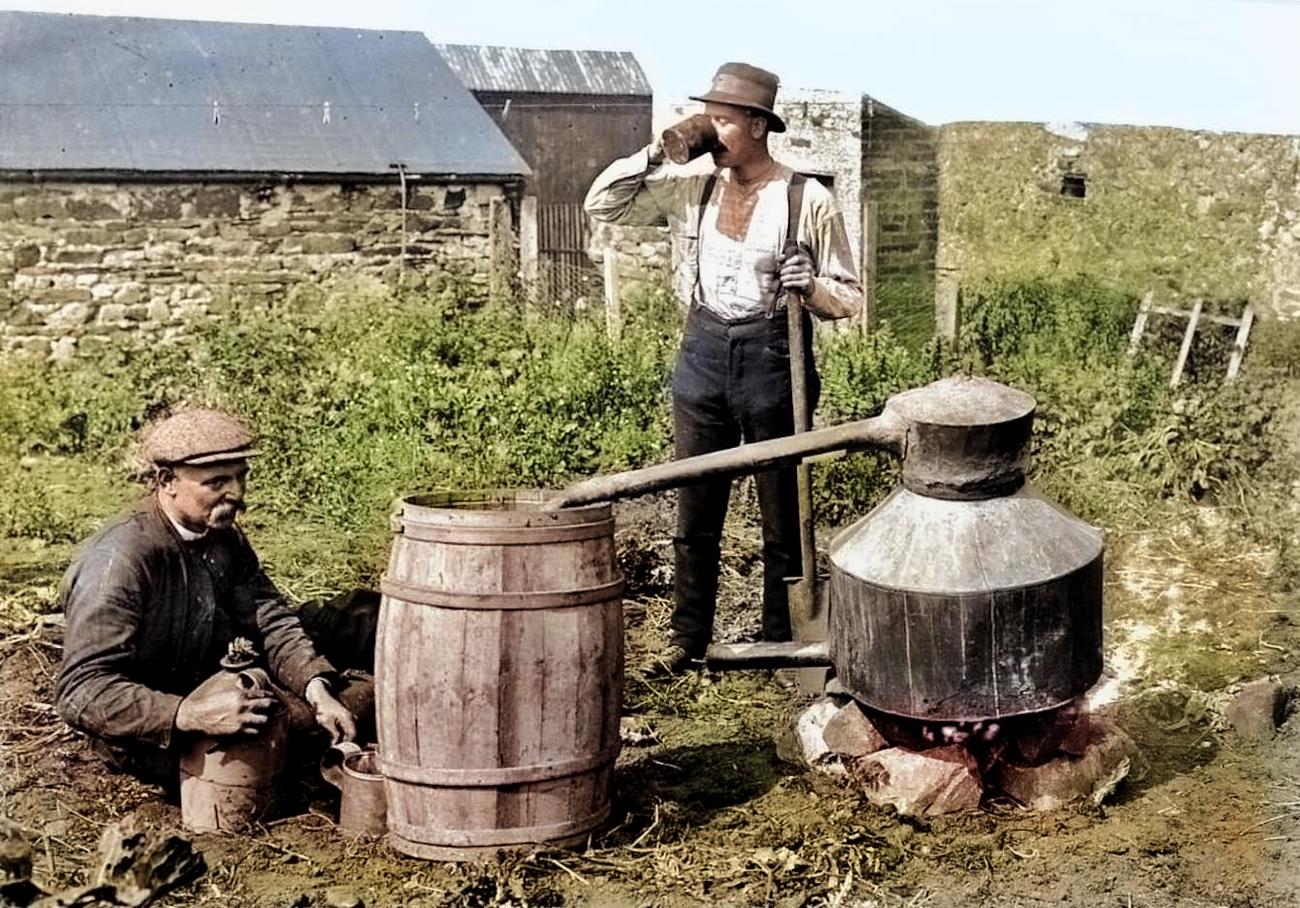
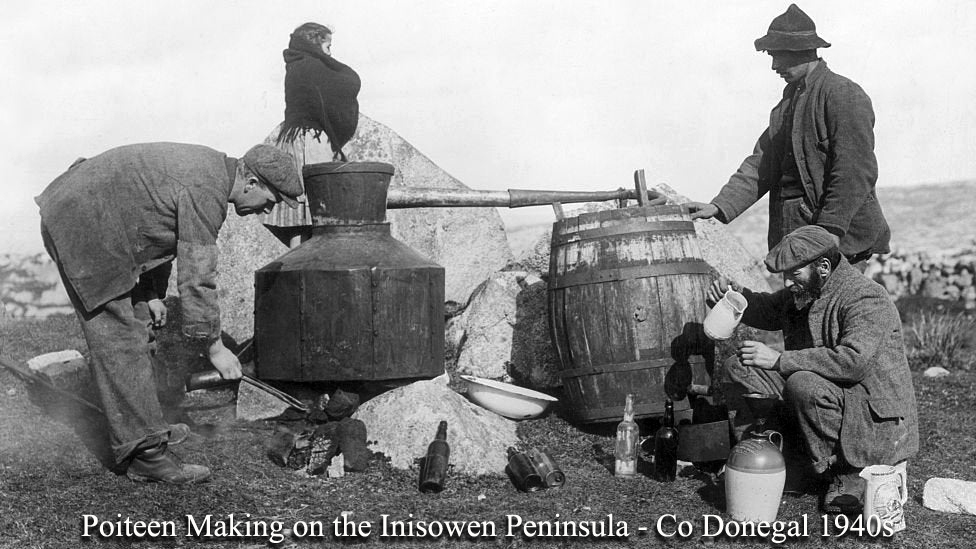
Poitín making in Donegal 1940s
On a remote bog near the Sligo /Mayo border, my 10 year old eyes were opened for my first and only experience of a poitín still in full operation. The year was 1956 and my father, on his annual holiday to his Sligo in-laws, my cousins, made his usual arduous trip to Glash, a remote and uninhabited peat bog near the Mayo county line. The annual ritual was to sample and buy his two annual bottles of freshly distilled poitín. In those days, young fellows like me, were made to be seen and not heard, and although the four hour expedition was a bit boring, it was a new and very different experience. The accommodation was the derelict remains of an old stone farm cottage with an improvised rusty roof. Corrugated galvanised sheets laid loosely on some loose timbers, all weighed down by heavy bog stones, keeping the visitors and production all dry and sheltered. Three people (all from the same family) were in charge of distilling – keeping the turf fire roaring hot and stirring the fermented ‘wash’. Finally, the pure clear distilled spirit came into being and made its entrance into creation. I thought at that point we were home and dry, but no! The tastings began, opinions thrown into the mix, a gentle sip, a little whiff, more opinions and to my dismay we were starting (almost) the last part of the process again, as the general consensus was ‘a wee bit weak’, so back it went for round two and second distilling. Many stories and tales of the past were told in the wait, which was about an hour. However, the final batch was put to the test once more, and through a variety of lip smacking, ooh’s and ah’s and other very contented sounds, the final opinion was unanimous ‘Jasus that’s mighty stuff’. After some handshakes and cash exchanges and arrangements for the next year’s gathering, everyone slowly went their separate ways, all with their freshly distilled and cleverly disguised bottles of their personal stash of the liquid gold or as they would always refer to it as ‘The Holy Water’.
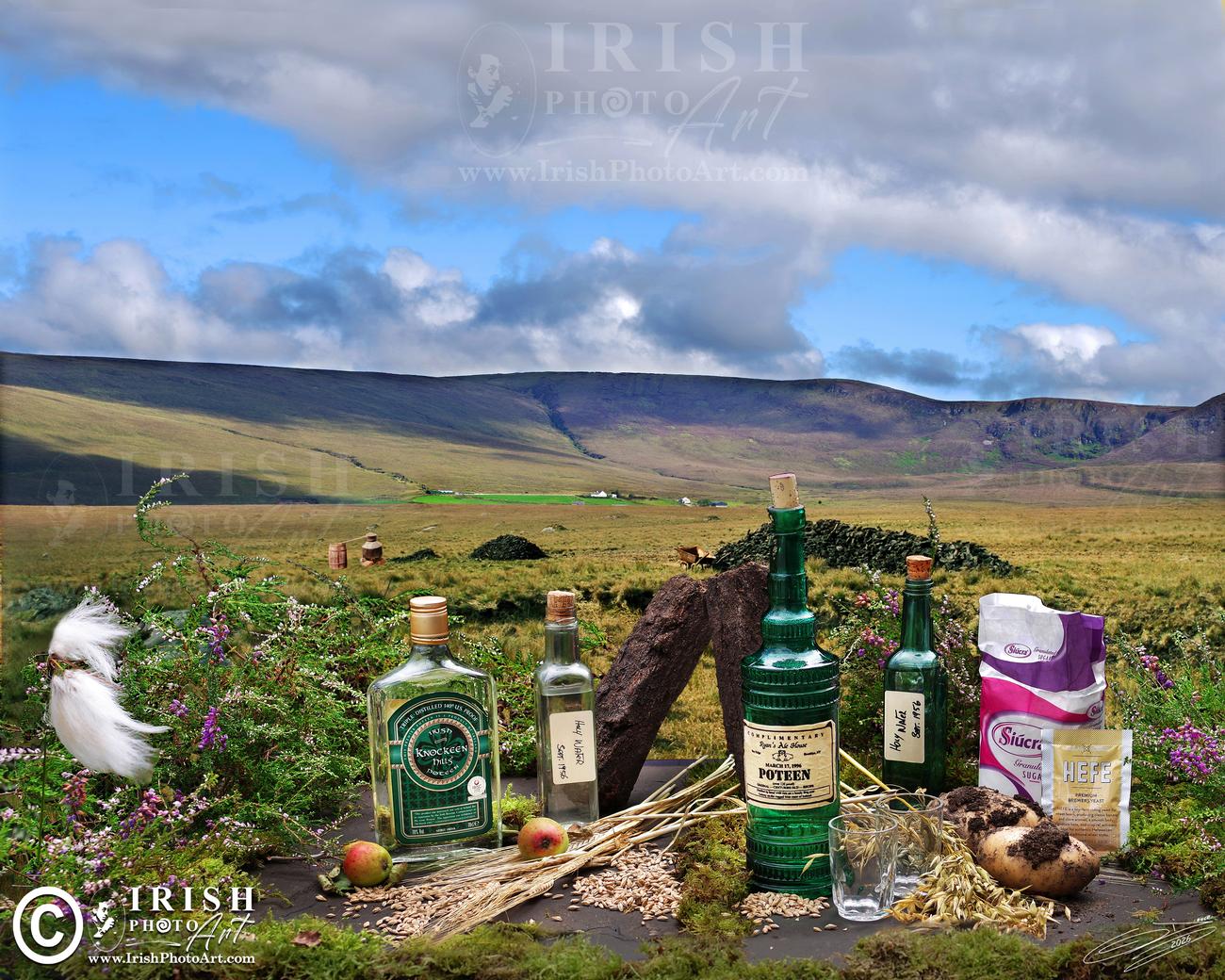
I hope the above yarn brings you to a place where you haven’t been before and to help you along, I have written a little verse as a sort of summery. Enjoy, or as they say around here ‘Slainte’.
“May the old roads never be forgotten,
May the turf fire always find a willing hearth,
May laughter linger longer than sorrow,
May every empty chair be filled with happy memories,
And may the stories of our people
Travel further than any of us ever could.
For while a story is remembered,
Those who lived it are never truly forgotten.”